

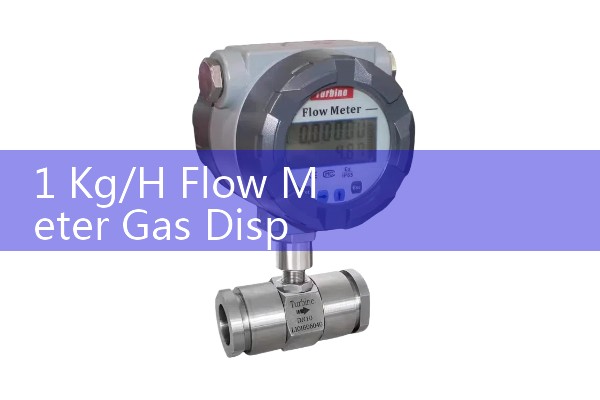
『1 Kg/H Flow Meter Gas Dispersion Calibration Rules』Related information(clamp on meter|electromagnetic meter|venturi meterrotameter|orifice meter|ultrasonic flow meter|mass flow meter|coriolis mass flow meter|coriolis flow meter|magnetic flow meter|magmeter flow meter|magflow flow meter|mag meter flow meter|electromagnetic flow meter|vortex flow meter|turbine flow meter|thermal mass flow meter|thermal flow meter|rotameter flow meter)
1 kg/h Flow Meter Gas Dispersion Calibration Rules: What Engineers Need to Know
Quick Answer: A 1 kg/h gas flow meter that uses thermal dispersion technology must be calibrated with the actual gas or a close equivalent. Air calibration with a correction factor rarely works below 2 kg/h for gases like methane, hydrogen, or biogas. The best accuracy comes from a NIST-traceable calibration rig running your real gas mixture at your actual operating pressure and temperature.
Why 1 kg/h Is a Hard Calibration Point for Gas Flow Meters
Most thermal mass flow meters on the market claim a turndown ratio of 100:1 or higher. But here is the thing. At the low end of 0.1 to 1 kg/h the signal-to-noise ratio drops hard. We have seen on customer sites many times. A meter that reads stable at 5 kg/h starts drifting at 0.8 kg/h. The sensor is still working. The calibration curve just does not have enough data points in that small flow region.
For a DN4 or DN6 pipe carrying 1 kg/h of nitrogen at 1 bar the actual velocity is extremely low. The heat removed from the heated sensor is tiny. Ambient temperature changes in the plant can be larger than the flow signal. That is why the calibration rules for this range get specific.
The Core Rule: Real Gas Calibration Is Not Optional Below 2 kg/h
Many engineers try to calibrate a dispersion flow meter on air and then apply a k-factor for natural gas or hydrogen. That works at 20 kg/h. At 1 kg/h it fails. The thermal conductivity and density effects do not scale linearly in the boundary layer region. A biogas plant in Thailand found a 12% error when they used an air-calibrated meter on real biogas at 0.8 kg/h. The same meter on a CH4/N2 mix calibration rig read within 0.5%.
If your process gas is flammable or toxic a safer path is to calibrate with a surrogate gas that matches the thermal properties. For example, helium is often used to simulate hydrogen below 2 kg/h because the thermal conductivity is similar. But you need a lab that understands gas dispersion conversion. Silver Instruments runs these conversions in our Shanghai calibration center. We use a primary standard gravimetric rig with a Mettler Toledo balance that reads to 0.001 g. The reference flow is generated by a syringe pump and a sonic nozzle array. The uncertainty is 0.3% of reading down to 0.05 kg/h.
Pressure and Temperature Compensation Rules
A thermal dispersion meter measures mass flow. That means it is immune to pressure and temperature changes in theory. In practice, at 1 kg/h, the compensation algorithm matters a lot. If the meter is calibrated at 2 bar and 25°C but installed at 6 bar and 40°C, the heat transfer at the sensor will shift. Most manufacturers use a lookup table or polynomial correction. At low flows the correction curve must be empirically mapped.
We have a rule. For any meter calibrated for a range that includes 1 kg/h, we ask for the exact minimum pressure and maximum pressure at the site. We then run a multipoint pressure validation. A typical customer in Australia running natural gas to a microturbine fuel line at 1.2 kg/h specified 3 bar. The actual site pressure fluctuated from 2.7 to 3.4 bar. The meter we supplied was validated at 2.5, 3.0, and 3.5 bar on the gas bench. The total error band stayed within 0.75%. Without that validation the error could have reached 3% because of the nonlinear pressure effect at the sensor surface.
Meter Selection for 1 kg/h Gas Applications
Not every thermal dispersion flow meter can handle 1 kg/h well. A full-bore meter with a DN25 body will have almost no velocity signal. The sensor element will sit in a dead zone. The correct approach is to use a small-bore sensor body such as DN4 or DN6. In some designs the sensor is placed directly in a capillary bypass. That increases the velocity at the sensing point. Silver Instruments model TMF-100 in the microflow version uses a 3 mm sensor tube. The flow range is 0.05 to 5 kg/h for nitrogen. The response time is under 1 second.
For corrosive gases like wet biogas or acid gas, a Hastelloy C22 sensor is necessary. The calibration rules do not change but the zero drift must be checked more often. A wastewater plant in Brazil runs a 1 kg/h biogas to flare meter. We recomme
How a Typical 1 kg/h Gas Dispersion Calibration Lab Run Looks
Here is a walkthrough of an actual calibration we did last month for a customer in Vietnam. The gas was a mixture of 90% methane and 10% CO2. The flow range was 0.2 to 1.5 kg/h. The meter was a DN6 thermal dispersion flow meter with a 4-20 mA HART output. The calibration steps were:
Step 1. Mount the meter on the test section. The inlet pressure is set to 2.0 bar abs via a high-precision regulator.
Step 2. The reference flow is generated by a Coriolis master meter on the same gas line. That master meter is calibrated against a gravimetric weigh scale every morning.
Step 3. Run the gas at 10 flow points. The points are 0.2, 0.3, 0.5, 0.7, 0.9, 1.0, 1.1, 1.3, 1.5, and 2.0 kg/h. At each point we wait for a stable reading for 120 seconds.
Step 4. The meter’s raw milliwatt signal from the sensors is recorded. A polynomial curve fit is generated. The residual error at each point is checked. For this run the maximum deviation was 0.42% at 0.2 kg/h and 0.15% at 1.0 kg/h.
Step 5. The coefficients are uploaded to the meter’s EEPROM. A final verification at 0.5, 1.0, and 1.5 kg/h confirms the meter accuracy.
The full report PDF is given to the customer. It includes the uncertainty budget, the gas composition, the ambient temperature, and the serial numbers of the reference instruments. This kind of paperwork is what an ISO 9001 audit wants to see.
Installation Rules That Affect Calibration Validity
A meter calibrated to 0.5% at 1 kg/h can lose all that accuracy if the piping is wrong. A straight run of 15D upstream and 10D downstream is the minimum. But at low flows, flow conditioning is sometimes worse than a simple tube. We tested a DN6 meter with a perforated plate flow conditioner. At 1 kg/h the conditioner actually created a small recirculation zone. The meter read 4% low. Removing the conditioner and giving the flow a 20D straight tube solved it.
Because the sensor is sensitive to thermal conduction, the pipe must be insulated if the ambient temperature is not constant. A diesel engine test cell in the Middle East had a 1 kg/h air flow meter that drifted every afternoon. The direct sun on the pipe heated the gas by 10°C. The meter did not have an inline RTD for real-time gas temperature measurement. We added a PT100 probe in the pipe 3D upstream. The transmitter compensated based on that signal. The drift stopped.
FAQ: 1 kg/h Gas Dispersion Meter Calibration
Question 1. Can I calibrate a 1 kg/h thermal meter on air and use it on hydrogen?
You can but the error will be large. Hydrogen has a much higher thermal conductivity. The meter will read high by 15 to 25%. At 1 kg/h that error is not acceptable for any custody transfer or process control. You need a real gas calibration or a validated surrogate.
Question 2. How often does a 1 kg/h meter need recalibration?
For clean dry gases once a year. For dirty or wet gases every 6 months. If the zero drift exceeds 0.2 kg/h during a field check, remove the meter and send it to a lab.
Question 3. What pipe size should I use for a 1 kg/h flow meter?
DN4 or DN6. A DN15 pipe will result in a velocity too low for a stable thermal signal. Silver Instruments TMF-100 microflow meter uses a DN6 process connection with a built-in flow channel of 3 mm diameter.
Question 4. Does temperature compensation help at 1 kg/h?
Yes. A built-in gas temperature sensor and a correct compensation algorithm are essential. Without them a 10°C change can shift the reading by 2 to 5% at 1 kg/h.
Question 5. How do I get a quote for a 1 kg/h gas flow meter calibrated to my exact needs?
Send us your gas composition, minimum and maximum flow in kg/h, operating pressure in bar, temperature in °C, pipe size (DN), and the output signal you prefer (4-20 mA HART, Modbus RS485, or pulse). We will provide a quotation with a calibration certificate matching your conditions.
 Hot Blog
 Related AD