

『K Factor Formula for Flow Meter Setup: Calculating Precise Constants from Gravimetric Weight Test Runs』Related information(clamp on meter|electromagnetic meter|venturi meterrotameter|orifice meter|ultrasonic flow meter|mass flow meter|coriolis mass flow meter|coriolis flow meter|magnetic flow meter|magmeter flow meter|magflow flow meter|mag meter flow meter|electromagnetic flow meter|vortex flow meter|turbine flow meter|thermal mass flow meter|thermal flow meter|rotameter flow meter)
K Factor Formula for Flow Meter Setup: Calculating Precise Constants from Gravimetric Weight Test Runs
Quick Answer: The K factor is a calibration constant that converts raw flow meter pulse output into a real mass or volume reading. For a gravimetric weight test run, calculate K factor by dividing total pulses by net weight collected on a calibrated scale. Use pulses per kg for mass output and pulses per litre for volume output after density correction.
Field engineers at Silver Automation Instruments often start with a simple problem. A flow meter leaves the factory with a default K factor. The process fluid is different, the pipe run is short, or the installation has air entrainment. The meter reading drifts from the weighbridge or tank level. A gravimetric weight test run corrects this in a few hours.
Why Gravimetric Weight Test Runs Work for K Factor Calculation
A gravimetric test uses a weigh scale, a collection tank, a timer, a pulse counter, and a stable flow loop. You divert flow into the tank for a fixed time. The scale gives net weight. The pulse counter gives total pulses from the flow meter. You do not need a master flow meter. You only need a traceable scale. We have seen customer sites in Southeast Asia use a 500 kg platform scale for diesel transfer meters and a 3000 kg floor scale for wastewater sludge lines. The scale accuracy matters more than the timer accuracy. A scale with 0.05 percent accuracy gives better K factor results than a hand-held stopwatch.
K Factor Formula from Gravimetric Test Data
Use this formula for liquid flow meters:
K factor = total pulses / net mass collected
If your meter reads in volume, convert net mass to volume using the fluid density at the test temperature. For water at 25 °C, density is about 997 kg/m3. For diesel at 30 °C, density is often 830 kg/m3 to 850 kg/m3. Check the batch density report from your lab.
Example: A Coriolis mass flow meter on a filling line produced 245 600 pulses during one test run. The weigh scale recorded 500.0 kg net. K factor = 245 600 / 500.0 = 491.2 pulses per kg. Enter 491.2 in the transmitter menu.
For an oval gear flow meter on diesel, total pulses 88 200, net volume 200.0 litres. K factor = 441.0 pulses per litre. If the same meter measured 200.0 kg of diesel at density 845 kg/m3, volume is 236.7 litres. The K factor becomes 372.6 pulses per litre. Do not mix mass and volume without density correction. This is a common error we see on customer sites in Latin America.
If you cannot run tests at the exact process temperature, use a PT100 sensor in the collection tank. Record the average temperature over the run. For hydrocarbon fuels, a 10 °C shift can change density by 1 percent or more. That error goes straight into the K factor.
Step by Step Gravimetric Weight Test Procedure
First, install a divert valve downstream of the flow meter. The valve should have a fast response time. A slow valve delays the start and stop boundary. That delay creates mass collection error. Use a pneumatic or solenoid valve if possible.
Next, place the collection tank on a calibrated platform scale. Tare the scale. Start the pump and wait for stable flow. Divert flow into the tank and start the pulse counter at the same moment. Stop the divert valve after 60 seconds or after a target weight is reached. Record total pulses and net weight.
Run the test at least three times. Use different flow rates if the process range is wide. Test at 25 percent, 55 percent, and 85 percent of the normal flow rate. Average the K factor results or program a multi point correction table if your transmitter supports it. Record pressure in bar and temperature in °C for every run. For liquid flow, keep back pressure at least 1.5 bar above vapour pressure. This is important for solvents, hot water, and low boiling point chemicals.
Which Flow Meters Need K Factor Adjustment
Not every meter uses the same K factor unit. Electromagnetic flow meters from Silver Instruments use a flow calibration factor in percent of reading. Vortex flow meters use pulses per litre or puls
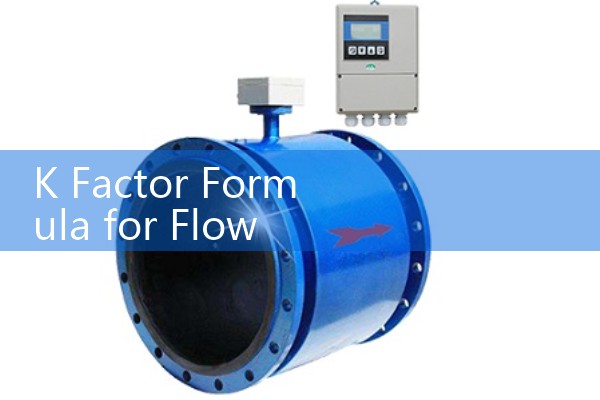
Example for a DN50 electromagnetic flow meter on a desalination plant line: The transmitter default K factor is 1.000. A gravimetric test gives actual volume 10.40 m3 versus meter reading 10.25 m3. New K factor = old K factor x (actual volume / meter volume) = 1.000 x 10.40 / 10.25 = 1.0146. Enter 1.0146 in the setup menu.
For a Coriolis mass flow meter, many users skip gravimetric testing because the meter measures mass directly. But if the pulse output feeds a PLC or batch controller, the K factor must still match the pulse scaling. We had a paint manufacturer in Southeast Asia with a DN15 Coriolis meter on solvent. The pulse output was set to 10 000 pulses per kg out of the box. The batch controller expected 5000 pulses per kg. A quick gravimetric run on a 30 kg solvent container corrected the setting in one afternoon.
Common Mistakes in K Factor Calculation
The first common mistake is mixing mass and volume. A kilogram is not a litre except for water at 4 °C and even then it is not exact enough for accurate batching. Always check density at the actual test temperature.
The second common mistake is trusting a large weighbridge for a small test container. A 30 000 kg weighbridge has too much resolution error for a 50 kg test bucket. Use a platform scale matched to the collection mass.
The third common mistake is ignoring entrained gas. Air bubbles add volume but not mass. An oval gear meter or Coriolis meter may read the bubbles differently. Keep back pressure high enough to avoid gas breakout. A clear sight glass at the meter outlet helps.
Product Data and Setup Support from Silver Instruments
Silver Instruments supplies Coriolis mass flow meters, electromagnetic flow meters, oval gear flow meters, ultrasonic flow meters, vortex flow meters, and thermal mass flow meters. We also provide pressure transmitters and paperless recorders for the same batching and custody transfer systems. Our technical team supports K factor calculations for DN2 to DN300 lines. Typical fluids include diesel, palm oil, seawater, brine, molasses, solvents, and wastewater sludge.
Send your pressure (bar), temperature (°C), pipe size (DN), and flow range to Silver Automation Instruments. Tel: +86-25-68650347. Whatsapp: +86-25-52155837. WeChat: +86 15365082610. Our team can prepare a K factor test procedure and recommend the correct meter for your process.
FAQ on K Factor Formula and Gravimetric Weight Test Runs
What is the K factor formula for a gravimetric test?
K factor equals total pulses divided by net mass collected. For volume output, divide total pulses by net volume after density correction.
How many test runs do I need for a reliable K factor?
Run at least three tests at different flow rates. Average the results within a stable linear range. Use a multi point table if the meter has wide turndown.
Can I use a truck weighbridge for a small flow meter test?
No. A large weighbridge has poor resolution for a 50 kg or 100 kg collection bucket. Use a platform scale with 0.05 percent accuracy or better.
Does a Coriolis mass flow meter need a K factor?
Yes, for pulse output scaling. The mass measurement is direct but the pulse output to a PLC or batch controller still needs the correct pulses per kg or pulses per litre.
What density should I use for a gravimetric K factor test?
Use the batch density at the actual test temperature and pressure. For water, use the value at the measured °C. For diesel and solvents, use a lab density report or a density meter.
Send us your test fluid, density, viscosity, pressure (bar), temperature (°C), pipe size (DN), and flow range. Our engineers will recommend the right flow meter and K factor setup for your gravimetric test. See flow-meter.com.au for product data sheets and technical notes.
 Hot Blog
 Related AD