

 Current position > Product detail
『Flow Meter with Remote Display Mounting: Placing Signal Converters Outside Hazardous or Harsh Areas』Related information(clamp on meter|electromagnetic meter|venturi meterrotameter|orifice meter|ultrasonic flow meter|mass flow meter|coriolis mass flow meter|coriolis flow meter|magnetic flow meter|magmeter flow meter|magflow flow meter|mag meter flow meter|electromagnetic flow meter|vortex flow meter|turbine flow meter|thermal mass flow meter|thermal flow meter|rotameter flow meter)
Flow Meter with Remote Display Mounting: Placing Signal Converters Outside Hazardous or Harsh Areas
Quick Answer: A remote display mount separates the flow sensor from the signal converter. You can keep the converter in a safe control room or a sealed cabinet, away from explosive gas, salt mist, washdown water, and high heat. Silver Automation Instruments supplies remote mount electromagnetic flow meters, Coriolis mass flow meters, and ultrasonic flow meters for these applications.
Why Remote Display Mounting Matters
Some flow sensors must stay in the pipe. The signal converter does not need to sit next to them. A remote display mount lets operators read flow data from a safe location. It also protects the electronics from damp air, corrosive gas, and direct sun.
In practice, many engineers choose remote mounting when the pipe runs through an ATEX Zone 1 area, a washdown bay, or an outdoor location with strong sun and rain. We have seen this on customer sites in Vietnam, Saudi Arabia, Chile, and Indonesia.
Which Flow Meter Types Support Remote Display Mounting
Electromagnetic flow meters are the most common choice for remote display installations. They handle conductive liquids from 5 µS/cm upward. A remote converter can be installed up to 30 meters from the sensor on standard shielded cable. For low conductivity liquids below 20 µS/cm, keep the cable between 10 and 15 meters.
Coriolis mass flow meters also support remote transmitters. They measure mass flow in kg/h, density in kg/m³, and temperature in °C. Remote transmitter distance depends on the meter size, but 15 to 50 meters is common.
Ultrasonic flow meters can use remote electronics for large pipes from DN50 up to DN3000. That option suits buried pipe runs and high level pipe racks where a local display is hard to reach.
Signal Converter Placement Rules for Hazardous Areas
In gas plants, solvent storage areas, and chemical dosing skids, the sensor may sit in ATEX Zone 1 or Zone 2. The signal converter should be placed outside the classified zone when possible. That gives you a safe area display and a simpler maintenance job.
Use shielded twisted pair cable between the sensor and converter. For cable runs over 20 meters, specify twin shielded cable with capacitance below 150 pF/m and a cross section of at least 0.5 mm². Keep the signal cable away from VFD motor cables. Ground the shield at one end only.
For electromagnetic flow meters, install grounding rings or use a grounding electrode to reduce signal noise. A paint manufacturer in Southeast Asia installed a DN100 electromagnetic flow meter in a Zone 2 solvent line. The remote display was placed 22 meters away in a safe MCC room. The converter stayed outside the gas zone and did not need an explosion proof enclosure.
Harsh Area Installation Practices
Water and wastewater plants often fail converters because of humidity, chlorine gas, and high temperature. A sealed cabinet with a small heater or ventilation fan solves most problems. Keep the converter temperature between 10 and 45 °C.
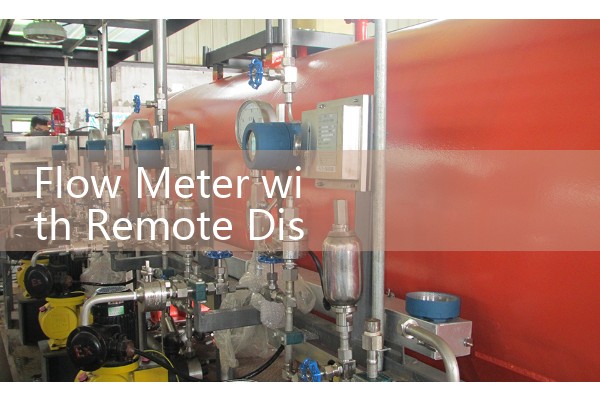
In desalination plants, salt spray attacks electronics quickly. A customer in Vietnam installed a DN20
Food and beverage washdown zones need a different approach. The sensor is often a hygienic style flow meter with a stainless steel body and PFA or PTFE liner. The remote display can sit at eye level outside the wet area, clear of hot water spray and cleaning agents.
Silver Automation Instruments Remote Display Options
Silver Automation Instruments supplies remote mount electromagnetic flow meters, Coriolis mass flow meters, and ultrasonic flow meters. Sizes range from DN15 to DN3000. Outputs include 4-20 mA HART, pulse output, and RS-485 Modbus. Many models accept PT100 temperature input for compensation.
For remote display applications, we recommend electromagnetic flow meters with PTFE or hard rubber liners and 316L electrodes for water, chemicals, and wastewater. For mass flow measurement, the Coriolis mass flow meter series handles flows from 0.1 kg/h to 500 t/h. The remote converter can be mounted in a GRP, stainless steel, or painted steel cabinet.
Our remote display kits include mounting brackets, cable glands, and pre-terminated cable in standard lengths of 10, 15, 20, 25, and 30 meters. Custom lengths are available on request.
How to Specify a Remote Display Flow Meter
Do not ask for a remote display flow meter without application data. Send us your pipe size in DN, fluid type, conductivity in µS/cm for electromagnetic meters, viscosity in cP for Coriolis or positive displacement meters, flow range in m³/h or kg/h, pressure in bar, temperature in °C, and hazardous area classification. For example, a distributor in Chile asked for a DN150 electromagnetic flow meter for copper tailings slurry with a 20 meter remote display. We quoted within two days.
Contact Silver Automation Instruments at Tel: +86-25-68650347 or WhatsApp: +86-25-52155837. WeChat: +86 15365082610. Our website is flow-meter.com.au.
FAQ
Can a remote display flow meter be installed in an ATEX Zone 1 area? Yes. The sensor can be rated for Zone 1. The signal converter should be placed in a safe area outside the zone when possible. This simplifies certification and maintenance.
What is the maximum cable length for an electromagnetic flow meter remote display? Most standard electromagnetic flow meters allow 30 meters of cable. For low conductivity fluids below 20 µS/cm, keep the cable shorter, around 10 to 15 meters.
Do remote display flow meters cost more than compact flow meters? Yes. You pay for the cable kit, the remote bracket, and sometimes a longer cable. The extra cost is usually recovered through longer converter life in harsh areas.
Which output signals are available on remote converters? Common options are 4-20 mA HART, pulse output, and RS-485 Modbus. Some models support PT100 input and batch control.
Can Silver Automation Instruments give a quotation without a site visit? Yes. Send your pipe size, fluid, flow range, pressure, temperature, and area classification. We can quote from our flow meter series without a site visit.